
My wife Janna and I run an Airbnb on our property in Prince Edward County. The County's own paperwork calls it an STA, short-term accommodation, but it's the same thing you'd list on Airbnb or VRBO. I'm not writing this as someone who has studied the market from the outside, I'm writing it as someone who has lived it, navigated the licensing process, dealt with guests, managed the calendar (well, mostly Janna), and figured out what actually makes the difference between a good Airbnb and a great one. If you're thinking about buying or already own property in PEC and want to understand how it actually works here, this is the honest version.
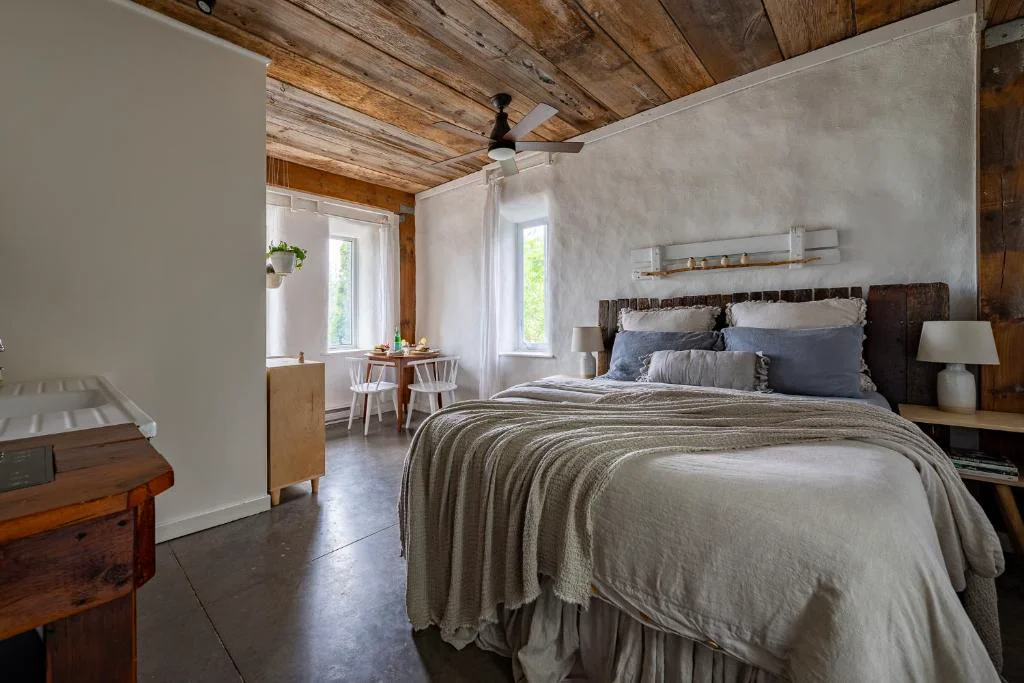
Inside our STA on the homestead, reclaimed wood ceiling, lime plaster walls, polished concrete floor. The space tells the story of the property.
What Are the Two Types of STA Licence in Prince Edward County?
In Prince Edward County, there are two types of short-term accommodation licences, and understanding the difference is the most important thing a buyer or prospective operator needs to know.
Primary Residence STA, This applies to a property where you, the owner, live for more than six months of the year. Within this category there are two sub-types:
Category A: you're on-site year-round and can rent a suite or portion of your home while you're present. Category B: you're on-site for most of the year but can rent the entire property for up to 45 days annually while you're away. This is what Janna and I operate, a suite on our primary residence property that we rent while continuing to live here.
Secondary Residence STA, This applies to a property that is NOT your primary residence: a cottage, investment property, or second home rented entirely to guests. Here's the critical detail: the County stopped issuing new secondary residence STA licences on September 20, 2022. If you're buying a property and hoping to run it as a full secondary STA, a licence is not something you can apply for from scratch, the only path is purchasing a property that already has one.
Does a Grandfathered STA Licence Transfer When You Buy the Property?
A licensed secondary residence STA in PEC carries what's called "legal non-conforming", or grandfathered, status. When that property is sold, the new owner can apply to continue operating under that licence. This makes those properties meaningfully more valuable than comparable unlicensed ones, and it's something buyers should be actively looking for if STA income is part of their plan.
But grandfathered status is not unconditional. To apply for the licence as a new owner, you need to establish that the use has continued, which means demonstrating rental receipts within the past 24 months. If the property has been sitting empty or has been used only as a personal retreat without documented guest stays, the grandfathered status may be at risk.
There are also physical conditions: the floorplan of the building must remain the same as when the original licence was granted. New bedrooms cannot have been added without proper permits and documentation. And the property still has to comply with current Fire Code, Building Code, life safety, and insurance requirements, grandfathered doesn't mean exempt from safety standards.
How Do You Get Licensed to Run an Airbnb on Your Primary Residence?
If you own your primary residence in PEC and want to operate a short-term accommodation on the property, you can apply for a primary residence STA licence. The process involves proving that the property is your principal residence, driver's licence, tax documents, utility bills in your name at that address, and meeting the County's fire and safety requirements.
On the safety side, expect to address things like: smoke and carbon monoxide detectors in all sleeping areas, fire extinguisher accessibility, proper egress from guest sleeping areas, and depending on the size and configuration of the unit, a fire inspection may be required. These aren't onerous if you're starting fresh and build them in from the beginning, they become expensive if you've already finished a space that doesn't meet code.
Insurance is its own conversation. Standard homeowner's insurance does not cover short-term rental activity. You need a policy that specifically includes STA or vacation rental use, talk to your broker before you list your first guest, not after.
Do You Have to Charge the Municipal Accommodation Tax on an Airbnb in PEC?
All STA operators in Prince Edward County are required to collect and remit a 4% Municipal Accommodation Tax (MAT) on every stay under 30 consecutive days. This applies to hotels, motels, inns, B&Bs, and short-term vacation rentals equally, there's no exemption for small operators.
In practice, this is straightforward: you add the 4% to your nightly rate as a separate line item (most booking platforms handle the calculation automatically), collect it from guests, and submit it to the County on the required schedule. Failing to register as a MAT collector and remit is a compliance issue, don't skip this step.
The revenue from the MAT is split: half goes to the municipality for tourism infrastructure, and half goes to tourism marketing organizations that promote the County to visitors. In 2025, the County collected $1,500,168 in MAT (Quinte News, April 2026). Your guests are contributing to the very marketing that brings more guests, it works in your favour.
How Much Can You Actually Earn Running an Airbnb in Prince Edward County?
PEC is one of the stronger short-term rental markets in Ontario. The tourism draw is real, the peak season is long by rural standards, and guests who come here tend to spend well. But the income varies enormously depending on your property type, location, quality of presentation, and how well you manage your pricing and calendar.
Source: AirROI short-term rental market data for Prince Edward, Ontario, monthly revenue by performance tier (updated July 2026).
August is peak, expect your highest rates and near-full occupancy if your listing is well-optimized. February is the low point. Spring and fall have been getting stronger as shoulder-season tourism grows in the County, driven by wineries, cycling, and the arts scene. A well-run waterfront or unique-concept property can command premium rates year-round.
Don't let the top numbers set your expectations without accounting for costs: platform fees (typically 3-5% on Airbnb), cleaning between stays, regular maintenance, supplies, and if you're not managing it yourself, property management runs roughly 10-12% of gross revenue. Run the actual math before you buy.
What Does Running a Successful Airbnb in PEC Actually Look Like?
The STAs that consistently outperform are not the nicest properties, they're the best-run ones. A clean, well-photographed, accurately described mid-range property with a responsive host and glowing reviews will outperform a beautiful property with poor communication and inconsistent cleaning every single time.
Photography matters more than almost anything else. Your listing photos are your storefront. Hire a professional or take the time to learn good interior photography, natural light, wide angles, styled spaces. Guests are scrolling dozens of options and making split-second decisions. Flat, dark, cluttered photos lose bookings to average spaces with great photos.
Pricing is dynamic, not set-and-forget. Tools like PriceLabs or Wheelhouse connect to your listing and adjust nightly rates based on local demand, events, seasonality, and competitor pricing. If you're manually setting a flat rate and leaving it, you're leaving money on the table in peak periods and losing bookings in slow ones.
Cleaning is your reputation. Guests will forgive a creaky door or an aging appliance, they will not forgive a dirty space. Establish a reliable cleaning team, do walkthroughs, and have a protocol for quick turnovers. This is where good STA operations get built or broken.
The guest experience beyond the booking. Clear check-in instructions, a thoughtful welcome, a local guide with your honest recommendations for restaurants, beaches, and wineries, these things generate five-star reviews. In PEC especially, guests want to feel like they're getting insider access to the County. You live here. Use that.
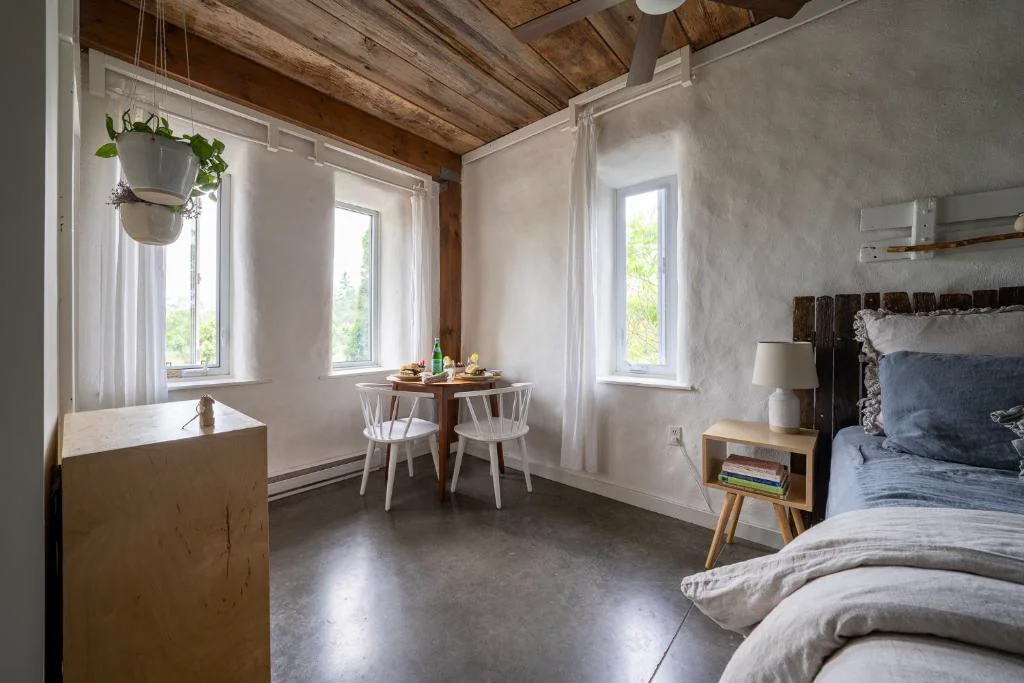

Details matter. The plaster texture, the hanging plants, the natural light, guests notice and photograph what makes a space feel different from a hotel room.
"The STAs that consistently outperform are not the nicest properties, they're the best-run ones."
Key Things to Know Before You Start
- No new secondary residence licences, the only way to operate a full STA on a non-primary residence is to purchase a grandfathered property
- Primary residence STAs are still available, if the property is your principal residence, you can apply to rent a suite or the whole home (up to 45 days/year)
- Grandfathered status transfers, but requires current licence, documented rental history in the past 24 months, and compliance with fire/safety codes
- 4% MAT is mandatory, register as a collector, add it to your nightly rate, and remit it to the County on schedule
- STA income is taxable, track your revenue and expenses carefully; deductions are available but so is CRA scrutiny
- Standard homeowner's insurance doesn't cover STAs, get the right policy before your first guest arrives
- Photography, pricing, and cleanliness are the three variables most within your control and most predictive of your results
- Contact PEC directly, rules evolve; always verify current requirements at sta@pecounty.on.ca or 613-476-2148 ext. 2050
Free Download
Get the Prince Edward County Airbnb & Short-Term Rental Guide
An eight-page PDF that walks through the licence types, the 2022 freeze, how to verify a grandfathered licence, and a printable income-property checklist. Free, no obligation.
Get the Free GuideFrequently Asked Questions
Yes, but the County calls it a short-term accommodation (STA) licence, and there are two kinds. If you live in the property more than six months of the year, you can apply for a primary residence STA licence today. If you don't live there, the County stopped issuing new secondary residence STA licences after September 20, 2022, so the only way to run a full-time Airbnb on a property you don't occupy is to buy one that already carries a transferable, in-good-standing licence.
For a property you do not live in, no. Under By-law 108-2021, the County stopped issuing new secondary residence STA licences for applications submitted after September 20, 2022. In practice you generally cannot buy a non-owner-occupied house or cottage in PEC and apply for a fresh STA licence today. The only way to own a non-owner-occupied STA is to purchase a property that already holds a licensed, in-good-standing secondary residence licence that can transfer to you. Primary residence STAs, where you live in the home more than six months of the year, are a separate category and are still available to new applicants.
A grandfathered secondary residence licence is tied to the property and can carry forward to a new owner, who then licenses it in their own name. Transfer generally requires that the licence is current, that there is documented rental history within the past 24 months, and that the property continues to meet all fire, building, life safety, and insurance requirements. Because a lapsed or non-compliant licence can be hard or impossible to restore, confirming the licence is active and in good standing is the single most important piece of due diligence on an income property. Always verify the current status directly with the County before you firm up an offer.
A primary residence STA is a home you live in more than six months of the year. You can rent a suite while you are on site, or rent the whole home while you are away for up to 45 days a year. A secondary residence STA is a property you do not live in, the classic income cottage. The County stopped issuing new secondary residence licences after September 20, 2022, so the only ones operating today are existing, grandfathered licences.
The penalties are deliberately steep. Failing to post your STA licence number on an advertisement carries a fine of $1,000. Operating an unlicensed short-term accommodation starts at $10,000 and can climb to $50,000 for repeat or egregious offenders. The licence number must appear on every listing and advertisement, which makes unlicensed operators easy to identify. The economics only work with a valid licence.
Yes. Prince Edward County applies a 4% Municipal Accommodation Tax on short-term stays. As an operator you register as a collector, add the MAT to your nightly rate, and remit it to the County on schedule. It is mandatory, not optional, and it should be built into your pricing rather than absorbed out of your margin.
It can be, but the rules have changed the math. Because new secondary residence licences are no longer issued, a property that already holds a transferable licence carries genuine scarcity value, and that should be reflected in both the price and the income you underwrite. Buy on documented rental history, a verified and transferable licence, real operating costs, and a conservative occupancy assumption, not on optimistic projections, and an STA property can still make sense.

Looking at an STA Property? Let's Talk It Through.
Whether you've found a licensed cottage and want a second set of eyes, or you're trying to figure out whether your plan is even allowed under the County's rules, send me a note. Honest, specific guidance, not a sales pitch.
The County market, once a month: no noise.
CLAR MLS data, honest analysis, and what it means for buyers and sellers across PEC, Belleville, Brighton, and Quinte West. One email a month.
- Sales volume, prices & days on market, straight from CLAR
- What's moving and what's sitting, and why
- Local lifestyle and real estate insight from someone who lives it