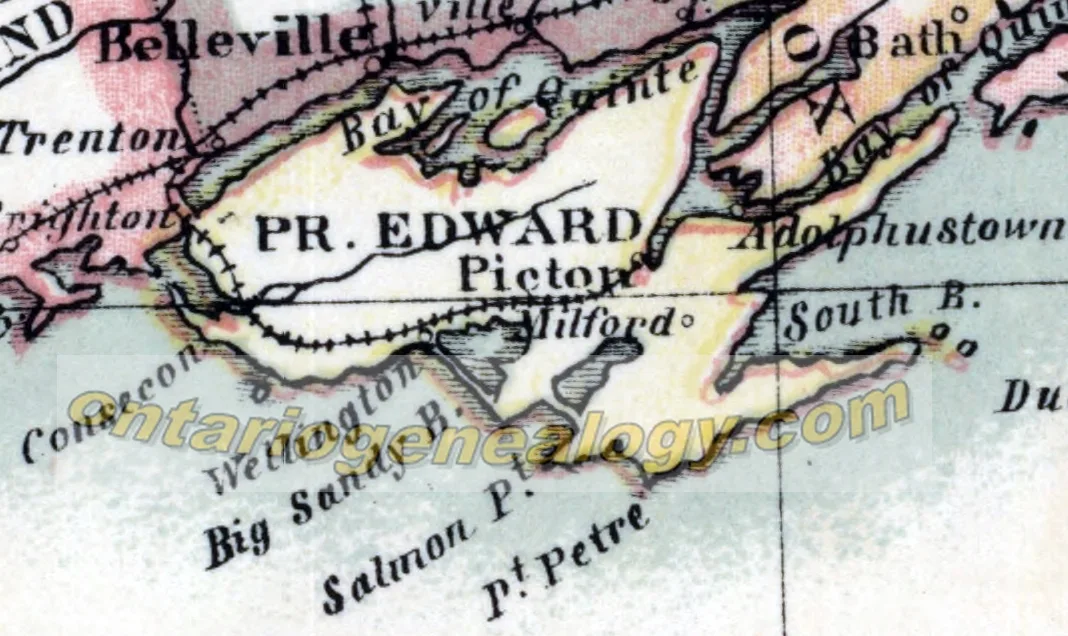

Most people arrive in Prince Edward County chasing something specific, a winery, a beach, a particular stretch of road they saw in a photo. They find it, and they think they've found the County. But Hallowell is where the County's story actually starts. It's the ward that built everything else.
Picton sits at the western end of Picton Bay, a deep natural harbour that made it one of the most important ports on this stretch of Lake Ontario throughout the 19th century. Loyalists settled here in 1784. Canada's first Prime Minister clerked in a law office here. The Regent Theatre has stood on Main Street since the 1920s. Shire Hall has been governing the County since 1874. Hallowell has a weight of history that no other ward in PEC can match, and a real estate market that reflects how much people still want to be at its centre.
What Hallowell Is Actually Like
Hallowell is Prince Edward County's institutional centre, but it doesn't feel institutional. Picton is a real working town, not a resort town, not a seasonal village, not a weekend destination that disappears in October. It has a hospital, a full secondary school, government offices, local shops, year-round restaurants, and the kind of Main Street that hasn't been entirely converted into galleries and tasting rooms. It's a place where people actually live.
The rural areas surrounding Picton are genuinely rural. Farms and acreage stretch inland from the bay in all directions, and the ward's outlying areas feel entirely separate from the harbour town at its heart, quieter, more agricultural, the kind of country that people are often surprised to find so close to a functioning town.
What makes Hallowell distinctly itself is the combination: heritage depth, a working harbour, a genuinely mixed community, and an increasingly strong winery and culinary culture that has developed alongside rather than replacing the existing character. The people who have been here for generations and the people who arrived last year both seem to like what they found.
- Picton Bay, a deep, sheltered natural harbour carved by retreating glaciers, used by First Nations for portage and later by Loyalist settlers and 19th-century commercial shippers. Historically one of the most important deepwater ports on this stretch of Lake Ontario. The waterfront park offers public access, walking trails, and views across the bay. There is nothing quite like it elsewhere in the County.
- The Regent Theatre, Picton's restored 1920s Edwardian Opera House on Main Street. It hosts theatre productions, concerts, film screenings, and community events year-round. It is genuinely one of the finest small-town theatres in Ontario, and its presence says something about the kind of community Picton has always been.
- Macaulay Heritage Park, a 19th-century heritage site within walking distance of downtown Picton, featuring period-restored buildings including a log cabin, schoolhouse, and St. Mary Magdalene Church. A grounding reminder of how long this community has been here and who built it.
- Shire Hall (1874), the county's governing seat, built the same year Alexander Graham Bell was experimenting with the telephone. It still functions as PEC's council hall today. The building is a heritage landmark in the truest sense: it actually still does what it was built to do.
- Wineries and farm estates, Hallowell sits at the edge of PEC's wine country, with rural properties suited to agritourism and estate use throughout the ward. The winery culture here feels quieter and less trail-driven than Hillier, a distinction that appeals to buyers who want the lifestyle without the weekend traffic.
Benjamin Hallowell was a Boston Loyalist who helped give his name to one of Ontario's most compelling communities, and never visited it once in his life. That is either the greatest irony or the greatest real estate regret in Canadian history.
The History Behind the Harbour
The earliest European settlers reached this part of the County in 1784, United Empire Loyalists who had lost property and position in the American Revolution and accepted Crown land grants to start over in British territory. Ebenezer Washburn was among the first, drawn like most of the early settlers by the shelter of the harbour. Picton Bay offered what few places along the Lake Ontario shoreline could provide: deep, protected water accessible to ocean-going vessels. That was not a coincidence of geography. It was the reason this community existed at all.
The township was established in 1797 by Lieutenant-Governor John Graves Simcoe and named after Benjamin Hallowell, a Boston merchant and Crown loyalist who had lost property in the Revolution and was compensated with land grants and an administrative appointment. The naming was a political gesture of recognition, Hallowell himself lived in England after 1776, later moved briefly to Toronto, and died there in 1799. He never saw the township bearing his name. Whether that qualifies as a missed opportunity or simply a sign of the times depends on your perspective.
Adjacent to Hallowell, Reverend William Macaulay laid out a new village in 1823 that he named Picton, after British General Sir Thomas Picton, who died at Waterloo in 1815. Picton was deliberately grid-planned, with Union Street as its spine, and it quickly became the judicial and commercial centre of the District of Prince Edward. In 1831, it was declared the district seat. In 1837, Hallowell and Picton amalgamated as the Town of Picton. That merger put the harbour community and the planned town under one name and set the template for everything that followed.
The Macdonald connection is one of the more overlooked facts about Picton's history. Before Confederation, before the Pacific Railway, before any of it, Macdonald was a young lawyer in this County town, learning his trade in the offices of the building that helped govern the district. The legal and civic infrastructure of Hallowell was not a backdrop to history. It was where history happened.
Letitia Youmans, born in 1827 in Picton, became one of Canada's most significant temperance advocates and a central figure in the women's rights movement. Her work helped shape national policy on alcohol and women's public participation at a time when neither was a settled question. A heritage plaque on Picton's Main Street marks her connection to the community.
Communities Within Hallowell
Hallowell extends from the Picton waterfront outward into a rural landscape that most visitors never reach. The communities within the ward have distinct characters, some urban, some deeply rural, connected by the county roads that radiate from Picton Bay.
- Picton, the county seat and Hallowell's centre of gravity. Main Street, the harbour, the hospital, Shire Hall, PECI, the Regent Theatre, the farmers' market, the grocery stores, the restaurants, all of it here. Picton is the most complete community in Prince Edward County in terms of services and walkability, and the only one that functions fully year-round. For buyers who want the County without the inconvenience of genuine remoteness, Picton is the answer.
- Picton's residential streets, beyond the commercial core, Picton's neighbourhoods extend through established streets of mature trees and 19th-century homes. Character varies by block: some streets are walkable village living, others are quieter and more spread out. The proximity to Main Street, the hospital, and PECI is consistent throughout.
- The rural ward, Hallowell extends beyond the town limits into farmland and countryside that most visitors never reach. Properties here offer more land and more quiet, within a reasonable drive of Picton's services. The character is genuinely agricultural, not lifestyle-rural, and buyers who want that distinction tend to know it when they find it.
Picton Bay: A Natural Harbour Unlike Anything Else in PEC
Most of Prince Edward County's waterfront faces open Lake Ontario or the Bay of Quinte, beautiful, exposed, and accessible. Picton Bay is something different. It is a deep, sheltered natural harbour carved by retreating glaciers, with a mouth narrow enough to provide real protection from open-water weather. Navigable by large commercial vessels, it sits apart from the broader Bay of Quinte system and has its own distinct character. There is nothing quite like it anywhere else in the County.
In the 1800s, that harbour was the economic engine of Prince Edward County. Grain, timber, and goods from across the County were transported to Picton and loaded onto ships that carried them to Kingston, Belleville, and eventually to markets across the province. The harbour drove the growth of the town, the legal and administrative institutions that followed, and ultimately the community's position as the county seat. That legacy is still visible in the scale and quality of the architecture on Picton's streets, buildings built by a prosperous harbour town that knew what it was.
Today, Picton Bay is both a recreational harbour and an active working port, a combination that is unusual in Prince Edward County and speaks directly to the depth and capability of the bay itself. The waterfront park offers public access, walking trails, and views across the water, where recreational boaters share the harbour with genuine commercial freighters. Picton Terminals operates on the bay as an inland deepwater cargo port, and large vessels including the 149-metre Stephen B. Roman still call regularly to load cement from the Lehigh plant on its shores, a direct, visible line back to the working harbour that built this town. Properties with bay views or direct access exist in limited supply and command significant premiums, and they trade rarely.
Who Hallowell Is For
Hallowell attracts a broader range of buyers than most PEC wards because Picton itself offers a broader range of reasons to be here. The community draws people who want the County's character without being far from services, people who are drawn specifically to the heritage and culture Picton carries, and people who want rural acreage but need a real town within twenty minutes.
- Buyers who want a real town, Picton is the only community in PEC with a hospital, a K-12 school, a full grocery store, and a year-round commercial core. If the idea of being 40 minutes from services is a dealbreaker, the solution is Picton. The County's character and conveniences both, without choosing between them.
- Heritage home buyers, Picton's residential streets hold some of the finest 19th-century architecture in Eastern Ontario: Georgian, Victorian, and Loyalist Neo-Classical homes with original details, mature trees, and character that simply cannot be replicated. If a heritage home is what you're looking for, the inventory in Picton is limited and in high demand, but it does come available.
- Waterfront and bay-view buyers, Picton Bay waterfront is rare, sheltered, and scenic in a way that Lake Ontario-facing properties are not. Supply is constrained, prices reflect that, and they have moved consistently upward. If Picton Bay frontage is available and fits your criteria, it typically does not wait long.
- Winery and estate buyers, Hallowell's rural areas include larger properties suited to agritourism, hobby farming, or estate use. The landscape is less wine-trail-saturated than Hillier, which means the rural character is more intact, an asset for buyers who want the lifestyle without the traffic.
- Families and long-term buyers, PECI serves K-12 across the county from Picton, and the community infrastructure around it, hospital, recreation centre, library, community programs, makes Hallowell a practical choice for families who intend to put down roots rather than weekend.
The Market
Property Types and Price Ranges
Hallowell's real estate market is more varied than any single number can capture. The ward contains Picton's town homes, Picton Bay waterfront, rural acreage in the surrounding countryside, winery estate properties, and everything in between. The approximately $804,000 average reflects that mix, the wide distribution across property types means no single type is the average.
| Property Type | Typical Range | What to Expect |
|---|---|---|
| Picton century homes and town homes | $650K,$950K | Established residential streets with mature trees and heritage character. Mix of renovated and original-condition homes. Walkable proximity to Main Street, the hospital, and PECI. Premium renovated heritage homes approach and exceed $1.2M. |
| Picton Bay waterfront | $1.1M,$2M+ | Rare, sheltered bay frontage that trades when it comes available. Deep water access, protection from open lake weather, and harbour views. Supply is genuinely constrained, these properties do not sit. |
| Rural acreage | $550K,$900K | Larger parcels in the countryside surrounding Picton, with agricultural character and more land per dollar. Variable soil quality and building condition. Well-suited to buyers who want acreage without waterfront pricing. |
| Farm and estate properties | $1M,$3M+ | Larger rural properties with significant land, outbuildings, and agricultural or agritourism potential. The upper end of Hallowell's market and a small, specialized pool. |
Pricing reflects a market where proximity to Picton's services, bay access, and heritage character all carry real premiums. The ward is consistently among the most expensive in Prince Edward County, and that position has been stable across multiple market cycles. The buyers who want what Hallowell specifically offers are willing to pay for it.
The Honest Take
What You Should Know Going In
Every community in PEC has realities worth naming before you buy. Hallowell is no different.
- Heritage homes carry heritage costs. The 19th-century buildings on Picton's residential streets are beautiful and genuine and often expensive to maintain properly. Windows, foundations, knob-and-tube wiring, plumbing that has been partially updated across multiple decades, these are not unusual findings. Budget for them honestly. The homes are worth it, but go in with your eyes open and a thorough home inspection in hand.
- Picton Bay waterfront is rare and priced accordingly. If bay access is the goal, understand that supply is genuinely limited and demand consistently exceeds it. Waiting for prices to soften is a reasonable strategy in most markets. On Picton Bay waterfront, it has historically not been a successful one.
- Picton is the service centre for the whole County, and it shows. Summer brings significant traffic through downtown Picton. Main Street in July is a different experience than Main Street in November. If you are buying in the town itself, that rhythm is part of what you are buying into.
- Rural Hallowell is genuinely rural. The ward's countryside is quiet in all seasons and requires a comfort level with rural living that the Picton properties do not. Internet connectivity, tradesperson availability, and winter road maintenance vary significantly from one address to the next, check each one specifically before deciding.
None of these are reasons to avoid Hallowell. They are the things worth knowing so that the community you end up with matches the community you expected to find.
Common Questions
Frequently Asked Questions About Hallowell
Hallowell is a ward of Prince Edward County, Ontario, and the administrative heart of the County. It encompasses Picton, the county seat, and the surrounding rural countryside. Hallowell Township was officially established in 1797 by Lieutenant-Governor John Graves Simcoe, though the first Loyalist settlers arrived as early as 1784. Today it is home to Shire Hall, the Regent Theatre, Macaulay Heritage Park, Prince Edward County Memorial Hospital, and the County's main secondary school. Average property values run approximately $804,000, tied with Athol as the second-most expensive ward in PEC.
Picton is the county seat and largest town in Prince Edward County. It sits at the western end of Picton Bay, a deep, sheltered natural harbour that was one of the most important commercial ports on this stretch of Lake Ontario during the 1800s. Today Picton is known for its 19th-century heritage architecture, the restored Regent Theatre, Macaulay Heritage Park, a strong local food and dining scene, and its role as the commercial and institutional hub of PEC. Sir John A. Macdonald, Canada's first Prime Minister, worked as a law clerk in Picton during his early career.
Hallowell offers some of the most diverse real estate in Prince Edward County. Heritage century homes and town homes in Picton typically range from $650,000 to $950,000, with premium renovated examples exceeding $1.2 million. Picton Bay waterfront properties are rare and typically begin above $1.1 million. Rural acreage in the surrounding countryside generally ranges from $550,000 to $900,000. Farm and estate properties at the upper end of the market can reach $3 million and beyond. The ward's average of approximately $804,000 reflects a genuinely wide distribution across property types and price points.
Picton, the main town in Hallowell Ward, is approximately 50 minutes from Kingston via Highway 33, crossing the Glenora Ferry and following the Lake Ontario shoreline, and approximately 35 to 40 minutes from Belleville via Highway 62. Both cities offer full hospital services, major retail, with Kingston offering airport services. Hallowell's central position within the County, combined with Picton's own services, makes it one of the least isolated addresses in PEC.

The County market, once a month: no noise.
CLAR MLS data, honest analysis, and what it means for buyers and sellers in Prince Edward County. One email a month.
- Sales volume, prices & days on market, straight from CLAR
- What's moving and what's sitting, and why
- Community guides and advice for buyers across PEC
No spam. Unsubscribe any time.