
Happy September, everyone. I hope you had a good summer. Mine came and went in a blink, and I am still not quite ready to admit the fall equinox is only two weeks out.
Something worth mentioning before we get into the numbers.
For a few months now I have been telling clients I think we are near the bottom of this cycle. Over the past couple of weeks the big banks have started saying the same thing, which is the first time in a while that my read and theirs have lined up.
RBC's latest housing outlook says the market is "finally taking steps toward a recovery." Resales have climbed every month since April, listings have stopped piling up, and the national benchmark price has stopped falling on a month-to-month basis. They are forecasting national sales up 6.7% in 2027 with prices roughly flat. TD is more reserved and puts the real rebound in 2027 rather than this year. BMO frames it as a slow walk back toward affordability rather than any kind of rally. CREA's economist called the soft patch earlier this summer a brief pause rather than a reversal.
So the fair summary is that it has stopped getting worse, not that prices are about to run.
There is also a regional wrinkle worth knowing. Ontario is actually leading this. Toronto, Hamilton, Kitchener-Waterloo, London and Ottawa all saw resales rise in July, and Toronto and Ottawa saw prices rise too. Meanwhile several markets that stayed strong through the downturn are now cooling: Quebec, the Prairies and Atlantic Canada all saw sales slip in July, and Halifax's price index has actually gone negative year over year the last two months. If that convergence continues, it is a better argument for a recovery here than a Canada-wide headline on its own would be.
Two things keep me from overselling it. RBC has called a bottom several times since 2022, and each earlier attempt got knocked over by a rate move or a trade surprise. And these are national figures, with Ontario specifically named as one of the slower provinces, so a Canada-wide headline does not automatically describe Prince Edward County or Quinte.
What I can tell you is that our own numbers point the same way, and the year-over-year picture below is the clearest evidence of it I have seen this year.
Back in April I wrote that Prince Edward County had moved decisively into a buyer's market, and the numbers behind that call were grim: 14.9 months of inventory, and 238 active listings competing for 16 buyers in a single month. Buyer's market, full stop, is how I put it at the time. It was as lopsided as I had seen it. Five months on, that gap has closed considerably. Inventory fell through the spring and summer, from 14.9 months in March to 9.4 in April, 6.9 in June, and 5.6 in July, which is inside the range most people would call balanced.
August loosened again to 8.5 months, and I want to be straight about why rather than skip past it. Thirty-four homes sold, down from 57 in July. That is a real drop, and it is the reason the inventory number moved. But active listings did not climb, they fell, from July's 317 to 288, and new listings dropped harder still, from 115 to 74. Supply did not flood back in. Buyers and sellers both went quiet for the last few weeks of summer, which is what August usually does here.
The comparison that matters is against last August, and it is the strongest part of this month's report. Thirty-four sales against 32 a year ago. Active listings down 9%. Months of inventory at 8.5 versus 9.9. New listings down 23%. On every measure of supply, the County is tighter than it was a year ago.
Price is the one line I would not sugar-coat. The average sale came in at $676,905 against $744,288 last August, and the median at $600,000 against $692,750. With only 34 sales in a month, a handful of high-end or low-end transactions swings that average hard, so I read one month of it as noise rather than a trend. Year to date the County is averaging $707,808 across 255 sales. Homes are also taking longer, 74 days on average, and still selling at 97% of asking.
So: not the seller's market yet, and I am not going to tell you it is. But the long stretch that ran entirely in buyers' favour has been narrowing all year, and August did nothing to reverse that.
August 2026 by the numbers
Prince Edward County
| Now | Last year | |
|---|---|---|
| New listings | 74 | 96 |
| Home sales | 34 | 32 |
| Avg sale price | $676,905 | $744,288 |
| Active listings | 288 | 317 |
| Months of inventory | 8.5 | 9.9 |
Brighton
| Now | Last year | |
|---|---|---|
| New listings | 50 | 67 |
| Home sales | 14 | 19 |
| Avg sale price | $613,129 | $665,763 |
| Active listings | 126 | 133 |
| Months of inventory | 9 | 7 |
Quinte West
| Now | Last year | |
|---|---|---|
| New listings | 106 | 89 |
| Home sales | 55 | 49 |
| Avg sale price | $582,828 | $565,447 |
| Active listings | 315 | 249 |
| Months of inventory | 5.7 | 5.1 |
Belleville
| Now | Last year | |
|---|---|---|
| New listings | 118 | 109 |
| Home sales | 68 | 59 |
| Avg sale price | $509,200 | $511,060 |
| Active listings | 292 | 293 |
| Months of inventory | 4.3 | 5 |
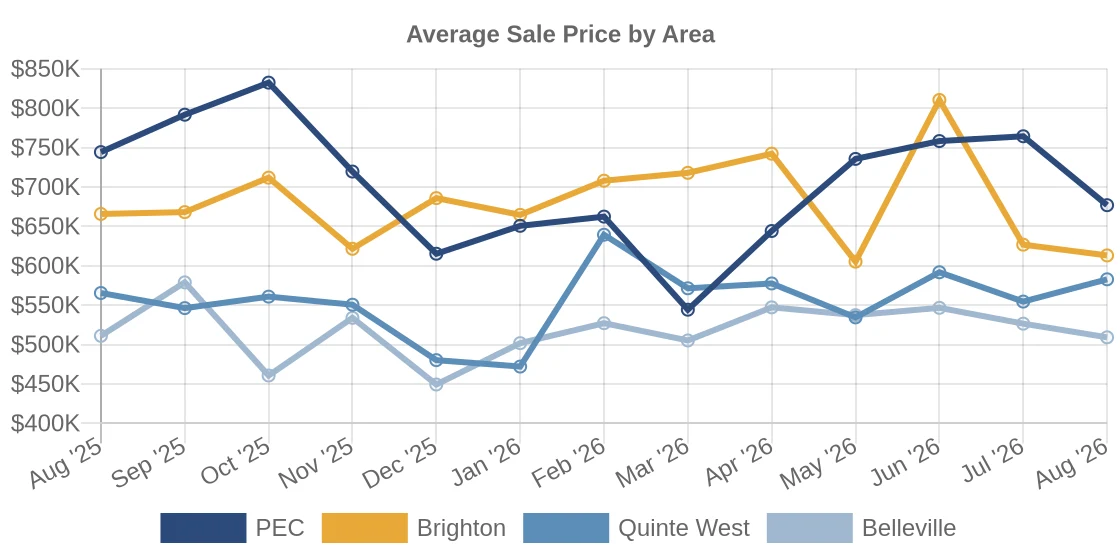
Average sale price by area, rolling 13 months. Source: Central Lakes Association of REALTORS® monthly statistics.
Interest rates
The Bank of Canada held its policy rate at 2.25% on September 2, the seventh consecutive hold. Prime stays at 4.45%.
What changed is the tone rather than the number. Governor Macklem's remarks pointed at inflation risk to the upside, citing energy prices kept high by the continuing conflict in the Middle East, and new US tariffs along with Canadian counter-measures after trade talks broke down. The economy came in stronger than expected as well, with GDP up 3.3% in the second quarter and unemployment easing to 6.4% in July. For most of this year the open question was when the next cut would land. That is no longer the question. The Bank is now openly discussing the conditions that would force a hike.
The next scheduled announcement is October 28, 2026.
Practically, if you have been waiting on the sidelines for rates to come down before you buy, that wait no longer has a clear finish line. And if your pre-approval is more than 60 days old, refresh it before you write anything.
What this means for you
If you're buying
You still have leverage in the County, and 8.5 months of inventory is a comfortable place to shop. But it is worth seeing the direction of travel. A year ago this month the figure was 9.9, and in March it was 14.9. The room you have now is real, and it is smaller than it was.
Two things in this month's numbers should shape how you make an offer. Homes took 74 days to sell on average, the longest stretch of the year, so there is no urgency premium on most properties. At the same time the average sale landed at 97% of asking, which tells you sellers who priced sensibly are not capitulating on the last few percent. A well-reasoned offer works far better here than a lowball.
If your search runs wider than the County, the regional picture split sharply this month. Belleville is the tight one at 4.3 months of inventory, with 68 sales, so expect competition on anything well priced. Quinte West sits at 5.7 months. Brighton is the surprise, loosening to 9.0 months from 7.0 a year ago on just 14 sales, which is the most buyer-friendly it has looked in a while.
On financing, prime is holding at 4.45% and the Bank of Canada is now talking about upside inflation risk rather than cuts. Waiting for cheaper money is a weaker strategy this month than it was last month.
If you're selling
The headline you will hear about August is that County sales fell from 57 to 34. Before that number worries you, look at what sat underneath it. Active listings fell, new listings fell harder, and both sales and inventory came in better than the same month last year. This was a quiet August, not a deteriorating market.
The number to pay attention to is 74 days on market, up from 60 in July and the slowest of the year. Combined with a 97% sale-to-list ratio, it says something specific: buyers are taking their time, but they are not grinding sellers down on price once they commit. What they are doing is skipping past anything that looks overpriced rather than negotiating on it. In a market with 288 active listings, being passed over is the real cost of an ambitious number, not a low offer.
If you have been listed more than 74 days without serious interest, that is the market telling you where it values the property. One meaningful adjustment tends to accomplish more than a series of small reductions, each of which resets your days on market in buyers' minds without changing the answer.
September and October are usually decent months here. Inventory is lower than it was a year ago, which means less competition for your listing than sellers faced last fall.
Get it in your inbox
The next issue, the day it comes out
One short email a month. No sales calls. Unsubscribe with one click, any time.