
My family lives in a straw bale house in the County. It was Janna's idea, and we built it ourselves on a bare piece of land. When people hear what the walls are made of, the questions come in a familiar order. Will it burn? Will it rot? Then, a little later: can you even insure a straw bale house? You can. But insurance, the mortgage and the building permit are three different gatekeepers, and the one most people never think about is the one that can sink a purchase.
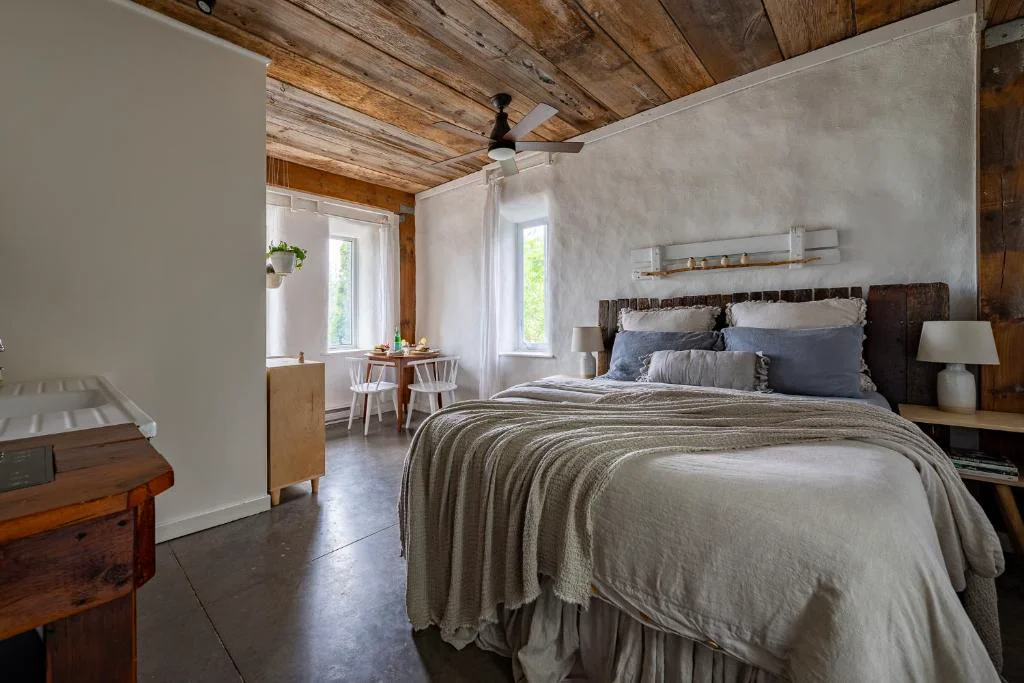
Inside our home: lime plaster over the bales, with the deep window sills that thick walls give you. This is the assembly an insurer will want described in detail.
The Short Answer
Three Separate Approvals, Three Separate Answers
Most straw bale owners in the one Canadian study I could find carried home insurance. The trouble is that people treat "approved" as one thing. A natural-built home has to clear three independent hurdles, and passing one tells you nothing about the next.
| Hurdle | Who decides | Straw bale outlook |
|---|---|---|
| Building permit | The municipal building department, under the Ontario Building Code | Doable. Usually needs engineering and more paperwork than a wood-frame house. |
| Home insurance | Each insurance company's underwriters | Often available. Expect extra questions, a referral to an underwriter, or a smaller list of companies willing to write it. |
| Mortgage default insurance | CMHC, Sagen or Canada Guaranty, through your lender | The hard one. Sagen lists straw bale as ineligible. Matters if you put down less than 20%. |
The Ontario Natural Building Coalition put it plainly in its October 2026 newsletter: meeting the building code does not mean an insurer will cover the house. The same goes for the lender.
Home Insurance
Can You Get Home Insurance on a Straw Bale House?
Insurers price risk from claims history. They have decades of data on wood-frame houses and very little on straw bale, hempcrete, cob or wood-fibre walls. When an underwriter sees an assembly they don't recognize, the file gets referred upstairs, the questions multiply, and some companies simply decline. That reflects the gap in their data more than anything wrong with the house.
The best Canadian evidence is old but useful. A CMHC-supported study, Straw Bale Construction in Atlantic Canada (2006), profiled 34 straw bale homes built between 1993 and 2006. Twenty-one carried home insurance. According to ONBC's summary of the study, the refusals were tied almost entirely to wood as the primary heat source, not to the straw walls.
Insurers weren't scared off by the straw. In that study, the wood stove was what got owners turned down.
The same data gap shows up in mass timber, where a federally supported industry report found builders' insurance rates running several times higher than concrete and steel, driven mostly by limited data and insurer unfamiliarity rather than demonstrated risk. Natural builds are a much smaller market with even less data, so expect underwriters to be cautious.
The Mortgage
Can You Get a Mortgage on a Straw Bale Home?
In Canada, if you buy with less than 20% down, your mortgage has to carry default insurance from CMHC, Sagen or Canada Guaranty. This is a different product from home insurance. It protects the lender, and the property itself has to qualify.
Sagen's published underwriting guidelines list straw bale and earth dome homes as ineligible for mortgage insurance, alongside things like raw land and chattel homes. I checked the page on October 15, 2026, and the wording is still there. I couldn't find a published straw bale rule from CMHC or Canada Guaranty either way, so ask your lender or mortgage broker directly before you count on one.
What this means in practice:
- Plan on 20% down or more if you're buying a straw bale home. Below that, financing may not be available at all.
- Talk to your lender before you write an offer, and tell them exactly what the walls are. Lenders who keep the mortgage on their own books, such as some credit unions, set their own rules.
- Keep a financing condition in the offer long enough for the lender to see the appraisal and the construction details.
Heat Source
Your Wood Stove Matters More Than Your Walls
Plenty of County homes, natural-built or not, heat with wood. If the house you're buying does, expect the insurer to ask for a WETT inspection (Wood Energy Technology Transfer) of the stove, chimney and clearances. Have it done early, keep the report, and be ready to say whether wood is the main heat or a backup. A house with a heat pump or propane as primary heat and a wood stove as secondary is usually an easier conversation with an underwriter than one that relies on wood alone.
We planned for this when we built. Our house has in-floor radiant heat run by an electric boiler, designed as the primary system, so it never depends on wood alone. In practice, we almost never turn it on. We heat with wood nearly all winter, and the radiant floor sits there as our backup. Having a full non-wood system in place is what I'd suggest to anyone building a natural home here, even if you end up loving the stove as much as we do.
Paperwork
What to Hand an Insurer: The Underwriting Package
A documented house is easier to insure. Drawing on ONBC's guidance, this is the file worth assembling, whether you're buying, selling or building:
-
01Engineered drawings and the code pathway
Architectural and structural drawings, plus how the design met the Ontario Building Code. Straw bale walls usually go through as an engineered design. The permit and the closed-out final inspection are the proof.
-
02Wall, roof and foundation details
Including the moisture strategy: how far the bales sit above grade, the roof overhang, and the plaster type. Moisture is the real long-term risk in a bale wall, and underwriters know it.
-
03Fire information and the wood appliance
Fire-resistance data for the plastered wall assembly, plus the WETT report on any wood-burning appliance.
-
04Who built it
Builder or designer qualifications, and comparable Canadian projects that used the same system. ONBC's professional directory is a good place to start if you need one.
-
05A specific description
Say "load-bearing straw bale walls with lime plaster on a frost-protected slab," not "a natural home." Vague answers trigger the referral. Exact ones let the underwriter look it up.
Your Situation
Buying, Selling or Building a Natural Home in Prince Edward County
If you're buying
Call an insurance broker before you firm up, not after. Ask the seller who insures the house now. A company that already covers that exact building is your quickest yes. Get copies of the permit, final inspection and any engineering letters as part of the deal, and line up financing with the 20% question already answered.
If you're selling
Build the binder before you list: permits, drawings, engineer's letters, WETT report, and the name of your current insurer. A buyer's broker and lender will ask for all of it. Having it ready keeps a conditional deal from stalling while someone hunts for paperwork from 2009.
If you're building
Bring a broker in at the design stage, describe the exact assembly, and ask four things: will you write it as standard, refer it, add a surcharge, or exclude it? How will replacement cost be calculated? Then arrange builder's risk and contractor liability coverage before the first bale goes up. If you're still looking for land, my guide to buying vacant land in the County covers the zoning, well and septic side.
What happened when we insured ours
I suspect most of the big national insurers would struggle to write a policy on a house built like ours. We never had to find out. We went to a local insurance company and had no trouble getting coverage. The heat source wasn't an issue either. Our wood stove is WETT certified, and that was all they cared about. If one company says no, keep going. A smaller local insurer may know these homes better than you'd expect.
Bottom Line
What This Means for You
Key Takeaways
- Straw bale homes are insurable in Canada. It takes more documentation and sometimes a smaller pool of insurers.
- Permit, home insurance and mortgage insurance are separate. Clearing one doesn't clear the others.
- Sagen lists straw bale as ineligible for mortgage insurance. Buyers with less than 20% down should confirm financing first.
- Wood heat is the usual sticking point. Get a WETT inspection and know your primary heat source.
- Paperwork wins approvals. Drawings, permits, engineer's letters and an exact description of the walls.
Frequently Asked Questions
Yes, in most cases. Insurers have little claims data on straw bale walls, so expect an underwriter referral, more questions, and fewer companies willing to quote. Engineered drawings, a closed building permit and a clear description of the wall assembly make approval much more likely.
It's difficult. Mortgages with less than 20% down need default insurance, and Sagen's underwriting guidelines list straw bale homes as ineligible. CMHC and Canada Guaranty don't publish a straw bale rule, so ask your lender before you make an offer. With 20% or more down, the lender sets its own policy.
Mostly unfamiliarity, and often the heat source. In a CMHC-supported study of 34 Atlantic Canada straw bale homes, 21 were insured, and the refusals were reported as tied almost entirely to wood being the primary heat source, not to the straw walls themselves.
A properly plastered straw bale wall resists fire well, because the tightly compressed bales leave little air to feed a flame and the plaster seals the surface. Insurers still want documentation of the assembly, and they look closely at any wood stove in the house.
Architectural and structural drawings, the building permit and final inspection, wall, roof and foundation details with the moisture strategy, fire-resistance information, a WETT report on any wood appliance, and the builder's qualifications. Describe the exact construction rather than calling it "natural" or "alternative."
Looking at a natural home or land to build on?
I've built one here. Happy to talk through what it takes.
Free Monthly Update
The County market, straight: every month in your inbox.
If you found this useful, you'll want the next one too. Once a month I send out a plain-language breakdown of what's happening across the Quinte region, real MLS numbers, no spin, no filler.
- MLS-verified sales data, prices, and days on market
- What's moving, what's sitting, and why
- One honest read from someone who lives here
- No spam. Unsubscribe any time. It's that simple.
Sent once a month. Your information stays private and is never shared.

Sources
- Sagen, Real Estate Underwriting guidelines (properties ineligible for mortgage insurance), checked October 15, 2026
- Ontario Natural Building Coalition, Insuring Bio-Based Buildings in Canada (Recommended Reading, October 2026)
- CMHC External Research Program, Straw Bale Construction in Atlantic Canada, Kim Thompson (2006)
- Canadian Wood Council and Climate Smart Buildings Alliance, Mass Timber Insurance Action Plan Phase 1 Report (March 2026)
- CMHC, What Is Mortgage Loan Insurance?
Photos: Jake Bergeron's own straw bale home in Prince Edward County. Underwriting rules vary by insurer and lender and change over time. This article is general information from Jake's own experience and the sources above. It is not insurance, mortgage or legal advice. Confirm coverage and financing with your own broker and lender.