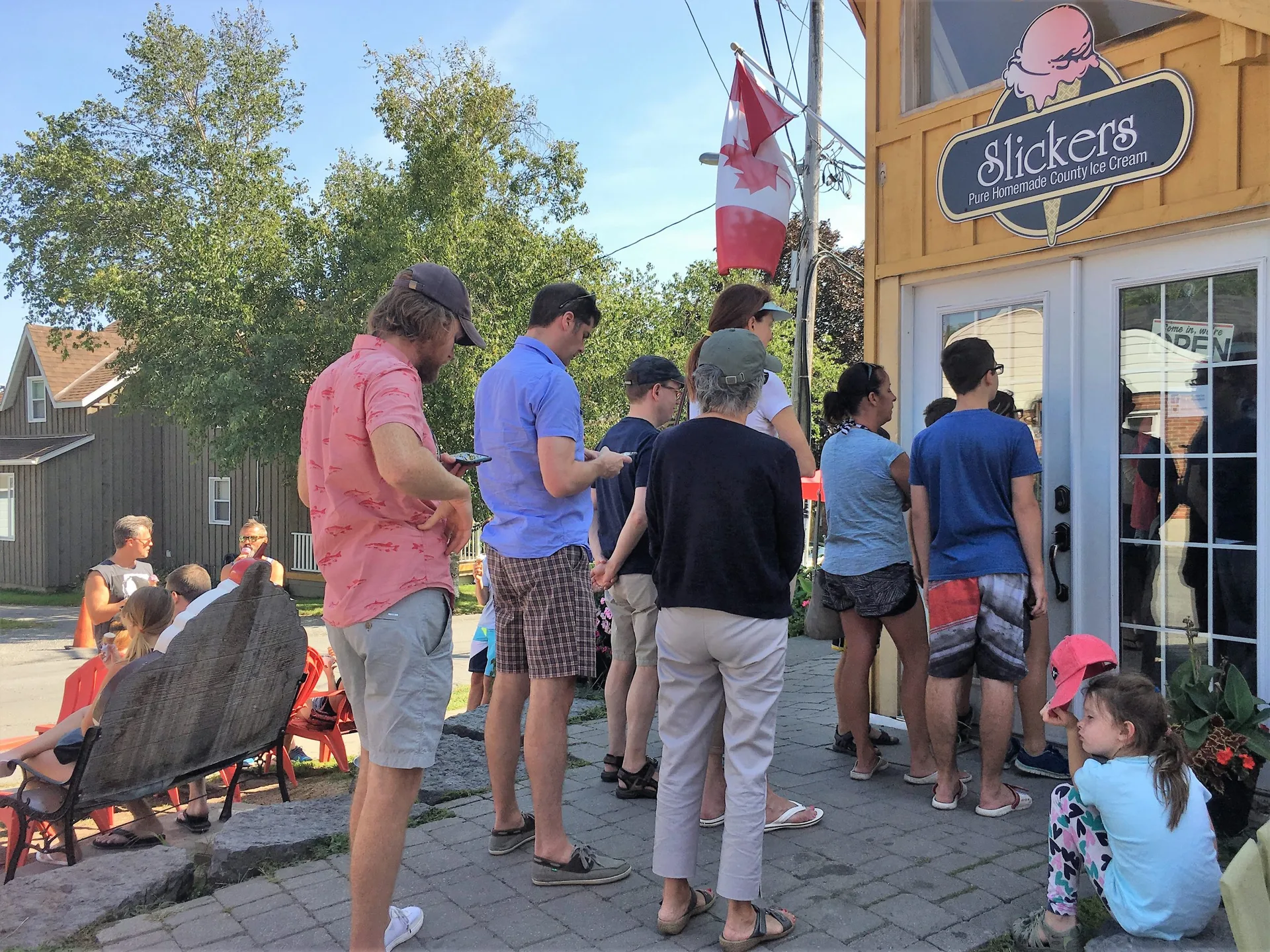

Bloomfield doesn't make a lot of noise, and that's exactly the point. It sits on County Road 33 between Picton and Wellington, seven minutes from one and ten from the other, close enough to everything you need and far enough away that it keeps its own rhythm. People who end up here usually made a deliberate choice. They looked at the whole County and decided they wanted the quiet version of it, the one with the best architecture and the least traffic.
What makes Bloomfield distinct isn't the amenities. It's the streetscape. The main street is lined with Victorian red brick homes built by a single craftsman, William Henry Degroffe, between 1850 and 1880, giving the village a visual coherence and warmth that you don't stumble into by accident. This is one of the finest collections of 19th-century heritage architecture in eastern Ontario, sitting on a County road in a village of 600 people.
This is the honest guide. What Bloomfield is actually like to live in, what the property market looks like, and who it's the right fit for, and who it isn't.
What Bloomfield Is Actually Like
Bloomfield is a Loyalist village with more than 230 years of continuous history, and it looks the part. Deacon John Adams led the first settlement here in 1789, and by the early 1800s Bloomfield was a prosperous milling community, its Genesee wheat flour was considered among the finest in the world, shipped to New York and London with the mark "Genesee Flour-Bloomfield." That prosperity built the village you see today.
The village was also a prominent Quaker community. Two historic Quaker cemeteries, the Hicksite Cemetery to the west and the Quaker Burying Ground to the east, remain on the edges of the village, quiet reminders of the community's founding character. The religious seriousness that shaped early Bloomfield still shows up in how the village carries itself: unhurried, unpretentious, genuinely itself.
- The architecture is the headline. William Henry Degroffe built the majority of the main street's fine homes between 1850 and 1880, red brick construction with distinctive cornices, verandas, and trim that give Bloomfield the most cohesive Victorian streetscape on the Loyalist Parkway. This isn't a mixed bag of styles. It's one craftsman's vision over thirty years, and it shows.
- A genuine food and dining scene. Flame + Smith is a wood-fired, farm-to-table restaurant drawing serious food travellers from across the province. Darlings, the village's beloved pizza spot, was named one of Canada's top restaurants in 2023. The food here punches well above what you'd expect for a village of 600 people.
- Working farms on Main Street. Bloomfield hasn't been fully sanitized into a boutique destination. Working agricultural operations still front the main street alongside the heritage homes and galleries, a mix that gives the village an authentic rural character that's increasingly rare in PEC.
- Arts, galleries, and creative community. Bloomfield has drawn a disproportionate number of artists, writers, and people who relocated from larger cities to build something quieter. The village hosts festivals and cultural events with a local character, not tourism programming, but community life.
- Picton is 7 minutes away. Wellington is 10. The practical infrastructure you can't find in Bloomfield itself is always close. Hospital, grocery, hardware, high school, all in Picton, seven minutes east on County Road 33. You're not trading off convenience for character here. You're getting both.
"The buyers who end up in Bloomfield are usually the ones who've thought the hardest about what they actually want. They're not chasing an address, they're choosing a life."
The Property Market
Real Estate in Bloomfield: What to Expect
Bloomfield's market is smaller and less liquid than Picton or Wellington, fewer transactions, more variation between properties, and a buyer pool that tends to be deliberate about what they're after. That creates opportunity for buyers who know the market and risk for those who don't.
The village core is dominated by heritage residential homes, the Degroffe-era red brick properties that define the streetscape. Many have been lovingly restored as private residences; others have been converted to bed-and-breakfasts and boutique accommodations. Rural acreage on the village periphery adds another dimension to the market, ranging from hobby farm properties to raw agricultural land.
| Price Range | What You're Typically Looking At in Bloomfield |
|---|---|
| $400K, $550K | Entry-level town homes, older bungalows needing updates, properties with deferred maintenance on smaller lots |
| $550K, $800K | Updated town homes with character, restored heritage properties in good condition, smaller rural lots just outside the village |
| $800K, $1.2M | Premium heritage restorations, rural properties with meaningful acreage and a quality home, established hobby farm operations |
| $1.2M+ | Exceptional heritage restorations, significant rural estates, heritage hospitality conversions with operating income |
Bloomfield generally offers better value than Wellington village for comparable property types, the tourism premium that has pushed Wellington pricing hasn't landed in Bloomfield to the same degree. That gap has been narrowing, but it's still real for buyers who know to look here.
One important nuance: properties marketed as "Bloomfield" can range from the village core to rural acreage several kilometres away. Understanding exactly where a property sits, and what that means for road access, services, and character, matters. Don't buy here without someone who knows the specific streets.
PEC Wine Country: Close, Not Around the Corner
Bloomfield gets mentioned alongside PEC wine country, and the proximity is real, but it's worth being precise about what that means on the ground, because the picture is often overstated in listings and travel writing.
The majority of Prince Edward County's 40+ wineries are concentrated in Hillier Township, roughly 20 minutes west of Bloomfield. Hillier is where the wine corridor is densest, and it's where most of the landmark producers have built their operations. Bloomfield itself has a small number of producers in the area, Huff Estates Winery and FieldBird Cider are the best-known with Bloomfield addresses, but the village is not surrounded by vineyards. It's a heritage village with agricultural land, some of which is farmed, some orchards, and some vineyard.
- Huff Estates Winery is genuinely nearby. One of PEC's established wineries, with a restaurant (Bantam) on site. It's the most accessible wine experience for Bloomfield residents and worth knowing about if you're considering the area.
- Hillier wine country is a short drive, not a walk. The concentration of PEC wineries, Norman Hardie, Closson Chase, and many others, is in Hillier Township. For Bloomfield residents, this is a 20-minute drive. Close enough to be a regular part of life, not close enough to be out your front door.
- The food and beverage scene is real and local. What Bloomfield does have, Flame + Smith, Darlings, local cafes and a speakeasy, is a genuine local food culture that exists independently of the wine tourism circuit. You don't have to drive to Hillier for an excellent meal.
- Sandbanks Provincial Park is about 15 minutes away. Ontario's most-visited provincial park, with some of the best freshwater beaches in the country, is an easy drive from Bloomfield. One of the underrated advantages of being centrally located in the County.
Services and the Practical Picture
Bloomfield is not Picton. The services picture is limited, and buyers need to understand that going in, not as a deal-breaker, but as a real factor in daily life. The people who love it here have generally made peace with the tradeoffs. The people who struggle were often surprised by them.
- Grocery and daily shopping require a short drive. Bloomfield has local businesses, but for a full weekly grocery run you're going to Picton, seven minutes east. Most residents build this into their routine quickly and don't find it onerous. It's a different habit, not a hardship.
- Healthcare is in Picton, 7 minutes away. Prince Edward County Memorial Hospital is in Picton. Belleville Regional Health Centre, the full-service regional hospital for specialist and complex care, is approximately 25 minutes north. For most residents this is entirely workable. For buyers with significant health needs or limited mobility, it's worth an honest conversation before committing.
- Schools mean commuting. Secondary school students travel to Prince Edward Collegiate Institute (PECI) in Picton. This is the norm across most of rural PEC, and local families are used to it, but families with young children should factor it into the decision.
- High-speed internet has improved. Fibre and rural broadband have expanded into much of the Bloomfield area, but confirm at the specific address, especially for rural properties outside the village boundary. For remote workers, this is non-negotiable and worth verifying before an offer.
- Trades and contractors, same story as everywhere in PEC. Book ahead. Rural properties in the Bloomfield area often have older systems, septic, well, heating, that need contractor attention. Assume longer timelines than you'd expect in a city.
The Honest Take
What Bloomfield Is Not
Bloomfield has a lot going for it, but it rewards buyers who are clear-eyed about what they're choosing. Here's what I tell people before they fall in love with the concept and overlook the reality.
- It's a small village, actually small. About 600 people, a handful of blocks, a modest main street. If you're coming from Picton or Wellington expecting a comparable amenity experience, you'll be underwhelmed. Bloomfield's strength is its character and quiet, not its density. That needs to be your priority, not a compromise.
- It's not a wine village. Bloomfield is near PEC wine country, not in the heart of it. If wine country access is your primary draw, Wellington puts you closer to the Hillier winery corridor. Bloomfield's identity is heritage and community, not viticulture.
- The "Bloomfield address" gets used loosely in listings. Some properties marketed as Bloomfield are genuinely in the village. Others are 5 or 10 km out on rural sideroads with a Bloomfield mailing address. Those are very different living experiences. Always know exactly where a property sits before you form an opinion about it.
- Off-season is quiet, very quiet. The village is peaceful year-round, but November through March is genuinely still. If you're coming from an urban background, visit in February before you buy in July. The village you fall in love with in summer is real, but so is the winter version.
None of this is a reason to avoid Bloomfield. It's a reason to choose it honestly. The people who are happiest here knew what they were getting and wanted exactly that.
Common Questions
Frequently Asked Questions About Bloomfield
Bloomfield is an excellent place to live for the right person, someone who wants the authentic Prince Edward County experience without the tourist traffic of Wellington or the busyness of Picton. It's a genuine heritage village with some of the finest Victorian architecture in eastern Ontario, a small but real arts and dining scene, and a tight-knit community of about 600 people. Services are limited, you'll drive to Picton (7 minutes) for the hospital and full grocery, but what Bloomfield offers in return is a pace and a character that's increasingly hard to find anywhere in Ontario.
Bloomfield was founded in 1789 when Deacon John Adams and 23 Loyalist settlers established a community in Hallowell Township, Prince Edward County. By the early 1800s it was a prosperous milling town, its Genesee wheat flour was considered among the finest in the world, exported to New York and London marked as "Genesee Flour-Bloomfield." The village was also a prominent Quaker community; two historic Quaker cemeteries remain. Most of the main street's distinctive red brick homes were built by local craftsman William Henry Degroffe between 1850 and 1880, giving Bloomfield the most cohesive Victorian streetscape on the Loyalist Parkway.
Bloomfield is approximately 7 minutes from Picton by car along County Road 33. Picton has the County's hospital, grocery stores, hardware, secondary school, and the full range of services that Bloomfield itself doesn't offer. The short drive makes Bloomfield practical for year-round living in a way that more remote County locations are not.
There are a small number of producers with addresses in the Bloomfield area, including Huff Estates Winery and FieldBird Cider, but the bulk of Prince Edward County's 40+ wineries are concentrated in Hillier Township, about 20 minutes west. Bloomfield is best understood as a heritage village with easy access to PEC wine country, not a wine destination in its own right. The Hillier wine corridor is a short drive, not a walk from your front door.
Bloomfield and Wellington are about 10 minutes apart on County Road 33. Wellington is larger, has a more established tourist profile, a beach on Lake Ontario, and the Wellington on the Lake adult lifestyle community, all of which drive higher property prices and more foot traffic. Bloomfield is quieter, more under-the-radar, and generally a better value. Wellington attracts buyers who want a walkable village with amenities; Bloomfield attracts buyers who specifically want the heritage character and unhurried pace of a genuine County village.

The County market, once a month: no noise.
CLAR MLS data, honest analysis, and what it means for buyers and sellers in Prince Edward County. One email a month.
- Sales volume, prices & days on market, straight from CLAR
- What's moving and what's sitting, and why
- Community guides and advice for buyers across PEC
No spam. Unsubscribe any time.