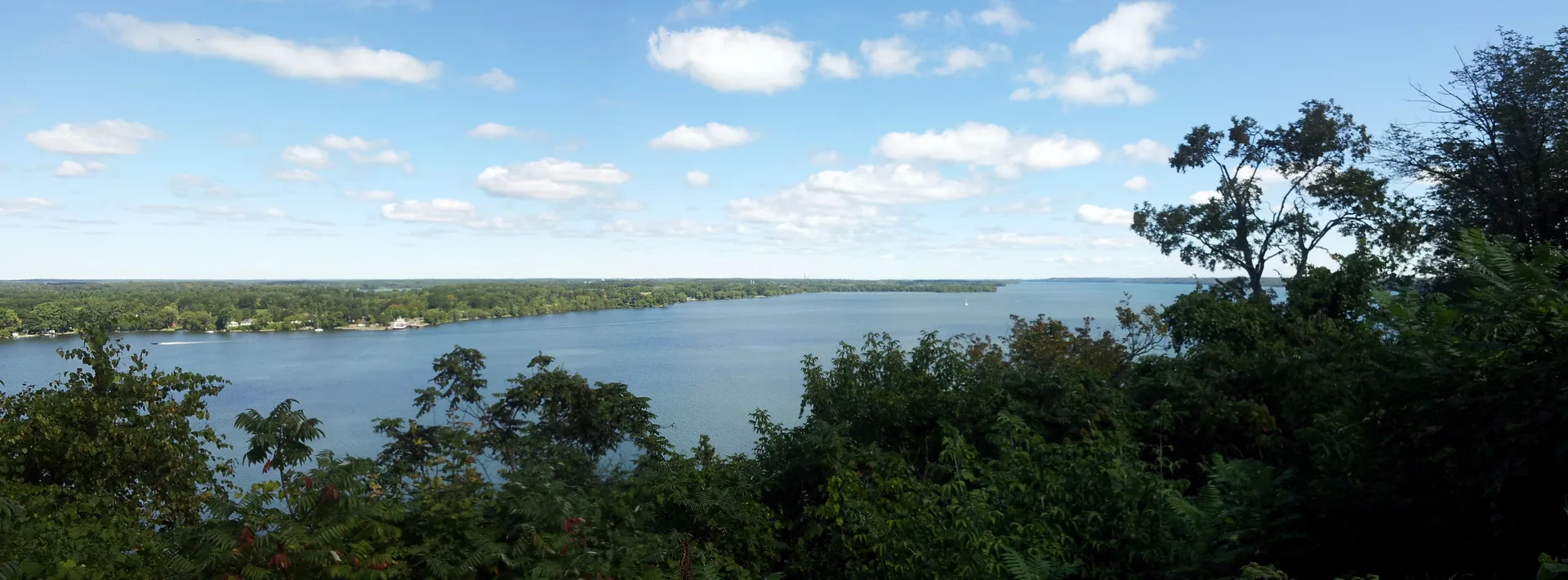

Most people come to Prince Edward County for the wine or the beach. North Marysburg isn't trying to be either of those things. It's the eastern edge of the County where the water runs in every direction, a free government ferry has connected the island to the mainland for nearly two centuries, and a lake sits impossibly perched 62 metres above the Bay of Quinte with no obvious explanation for how it stays full. This is the ward where Canada's founding history is still visible in the landscape, and where you can buy an orchard, take the ferry to the mainland, and be back in time for dinner at a winery with 700 feet of waterfront.
North Marysburg doesn't get the tourism traffic that Wellington or Picton attracts. That's the point. It's quieter, more rural, and more honest about what it is: one of the most historically layered corners of Ontario, shaped by Mississauga First Nations peoples, United Empire Loyalists, limestone geology, and a geography that has made "island consciousness" a real part of how people live here.
This is the honest guide. The history, the geography, the communities, and what the property market actually looks like for buyers who are seriously considering the ward.
The History That Shaped This Ward
Before the Loyalists arrived, North Marysburg was Mississauga territory. The people of the Mississauga First Nation understood this landscape in ways that took settlers generations to learn: they summered on Waupoos Island offshore in Lake Ontario and wintered in the mainland valleys, moving with the seasons along trails that are still traced by roads today. Chief Waupoos himself gave the eastern end of the ward its name, and Waupoos Island holds burial grounds that are among the oldest Indigenous heritage sites in the County.
When British surveyors arrived in 1783 and 1784, they were mapping a landscape the Mississauga had managed for centuries. The township was designated "Marysburgh", named, like the other early County townships, in honour of one of King George III's daughters. And the first Loyalists to set foot here came ashore at what became known as Prinyer's Cove in the fall of 1784, led by Lieutenant Archibald MacDonnell, becoming the founding settlement of a community that is now over 240 years old.
The mills at Glenora were among the earliest industrial operations in the County. Major Peter Van Alstine built grist and sawmill operations there in the late 1700s, and the village was originally called Stone Mills, a name that tells you what mattered most. By the 1820s, a Hugh Macdonald had taken over the Glenora flour and carding mills. His son, John A., would go on to become Canada's first Prime Minister. The family connection to North Marysburg is a quiet piece of Canadian history that still surprises people when they hear it.
"Hugh Macdonald ran the Glenora mills in the 1820s and 30s. His son grew up to become Canada's first Prime Minister. The history here has a long reach."
The Glenora Ferry: Part of Highway 33
The Glenora Ferry is the most practical and most poetic thing about North Marysburg. It's a free, year-round government ferry that crosses the Adolphus Reach, the narrow passage between Prince Edward County and Adolphustown on the mainland, and it has been making that crossing, in one form or another, since at least the 1820s. Documents reference ferry tenders as early as 1833. The vessel has changed. The need has not.
Today the ferry is operated by the Ontario Ministry of Transportation as part of Highway 33, the Loyalist Parkway. That means it's not a tourist attraction or a seasonal amenity, it's an official provincial transportation corridor, available at no charge, 19 hours a day. If you live in North Marysburg and need to get to Napanee, Kingston, or anywhere east without driving through Picton, the ferry is how you go.
Peak season (May long weekend to Thanksgiving) brings two ferries running with 15-minute service during the busiest hours of the day. Off-season, service runs every 30 minutes. The height restriction is 4.1 metres, so most passenger vehicles, SUVs, and light trucks cross without issue.
For residents of North Marysburg, the ferry is more than logistics. It's a cultural marker. People here have an "island consciousness" that is different from the rest of PEC, a sense of place that comes from living at the end of the road with a body of water between you and the mainland. First-time visitors often say crossing it feels like entering a different world. Residents will tell you it's the best part of the commute.
Lake on the Mountain: The Lake That Shouldn't Exist
Just above Glenora, on County Road 7, there is a freshwater lake sitting 62 metres above the Bay of Quinte. This is not a figure of speech. Lake on the Mountain is a full, open-water lake perched on a limestone cliff, separated from the Bay far below by a narrow strip of land, and it has no obvious water source dramatic enough to explain why it's full. Early settlers, facing something they couldn't account for, decided it must be bottomless. It wasn't, a 1964 survey established the depth at 30 metres, but the mystery outlasted the legend.
The lake drains eastward down the cliff face into the Bay of Quinte below, you can see the stream. It is fed by at least two small inflows from higher ground to the west, plus seasonal spring runoff from the southeast. But the volumes don't obviously explain the lake's consistent water level, which has stayed essentially constant across centuries of observation.
The most accepted geological theory is that Lake on the Mountain is a collapsed doline, a type of limestone sinkhole. Over thousands of years, the underlying bedrock dissolved and subsided, forming the basin. The limestone geology that underlies all of Prince Edward County is what makes the formation possible. It also makes the wine so good, but that's a different section of this guide.
The Mohawk people called the lake Onokenoga, "Lake of the Gods." Each spring, they offered gifts at its shores to honour the spirits believed to dwell in its waters and ensure a good season ahead. That name reflects something that science still hasn't fully resolved: this lake sits where it shouldn't be, full of water it shouldn't have, and it has done so for as long as anyone has been here to notice.
Lake on the Mountain Provincial Park surrounds the lake today, with picnic areas, walking trails, and the Lake on the Mountain Inn, a historic building dating to the late 1700s that now serves as a restaurant with views across the Bay of Quinte. On a clear day, you can see across to the mainland. On the right evening, the light over the water is something people drive an hour to see. For residents of North Marysburg, it's five minutes from home.
Glenora, Waupoos, and What's Between Them
North Marysburg is a ward, not a single village, it encompasses several distinct communities, each with its own character, connected by the Loyalist Parkway and the north shore of Lake Ontario.
- Glenora is the western gateway, the ferry hub, the historic mill village (originally called Stone Mills), and the jumping-off point for Lake on the Mountain just above. The heritage farmsteads and barns near the ferry dock are some of the most photographed scenes in the County. It's quiet, it's historic, and it has exactly the infrastructure it needs: a dock and a road.
- Prinyer's Cove is where it all started. Lieutenant MacDonnell landed here in 1784 with the first Loyalist settlers. The cove is peaceful today, its historical weight invisible unless you know to look for it. For buyers drawn to provenance, this is as deep as it gets in Prince Edward County.
- Waupoos anchors the eastern end of the ward on Smith's Bay. This is where the County's wine industry was born, where the orchards make the cider, and where you'll find one of the most distinctive properties in all of PEC: a waterfront winery on a 100-acre estate started in 1993 when nobody was sure PEC grapes were possible.
Waupoos: Where PEC Wine Was Born
The wine industry that now defines Prince Edward County's identity across Canada started in Waupoos in 1993, when Ed Neuser and Rita Kaimin established Waupoos Estates Winery on a 100-acre waterfront property on Smith's Bay. At the time, there was no PEC wine industry. They were the first. Today, Waupoos Estates is the only winery in Prince Edward County located directly on the water, with 700 feet of shoreline, 20 acres of vineyards growing 18 different varieties, and a farm-to-table restaurant that draws visitors from across the province.
But Waupoos is more apple than grape. The eastern ward is orchard country, the combination of Lake Ontario's moderating influence, well-drained limestone soils, and the micro-climate created by Smith's Bay makes it ideal for apple growing. The cideries here have won national awards. County Cider Co. operates out of a heritage-designated property called the Conrad David House, a stone farmhouse once owned by Sir John A. Macdonald, Canada's first Prime Minister, whose father had worked the Glenora mills just down the road a generation earlier.
- Waupoos Estates Winery, the first in PEC (1993), 700 feet of Lake Ontario waterfront, 18 grape varieties, farm-to-table dining and award-winning wines.
- County Cider Co., craft cider made from estate apples on the former Macdonald family property; one of the County's most distinctive agricultural operations.
- Clafeld Cider, award-winning hard cider produced from on-site crushed apples, with a licensed patio overlooking the lake.
- Fifth Town Cheese Co., handmade artisan cheeses from local goat and buffalo milk, including the Cape Vessey that's appeared on menus across the country.
- Cressy Mustard Co., award-winning craft mustard from nearby Cressy, part of a growing artisan food economy that makes Waupoos a serious foodie destination.
- Seasonal pick-your-own operations, berries, apples, and farm-gate produce that change with what's ready, not what the calendar says.
The Property Market
Real Estate in North Marysburg: What to Expect
North Marysburg is not where you go if you want a turnkey weekend cottage fifteen minutes from a wine trail. It's where you go if you want land, history, waterfront access, and a lifestyle that is genuinely rooted in the County rather than built around it. The buyers who thrive here tend to know exactly what they want, and they've usually driven the ward at least twice before making an offer.
The property mix is distinct from other wards. Working and hobby farms, heritage farmsteads, orchard properties, and waterfront on both Lake Ontario and the Bay of Quinte define the market. The tourism premium that has pushed pricing in Wellington and Hillier hasn't landed in North Marysburg to the same degree. That gap is narrowing, but it's still real for buyers who know to look here.
| Price Range | What You're Typically Looking At in North Marysburg |
|---|---|
| $400K, $600K | Rural lots and entry-level farmhouses needing renovation, smaller acreage properties with older structures, bare land with road frontage |
| $600K, $900K | Updated rural homes with meaningful acreage, heritage farmsteads in good condition, non-waterfront properties with views and established outbuildings |
| $900K, $1.5M | Waterfront on Lake Ontario or Smith's Bay, quality farm estates, renovated heritage properties, hobby farms with established operations |
| $1.5M+ | Premium waterfront, significant agricultural estates with income potential, heritage properties with exceptional character and condition |
One thing to understand about this ward: properties here are often significantly larger than what the same money buys near Picton. If acreage, privacy, and agricultural character matter to your decision, North Marysburg consistently offers more of all three for the same price point. Waterfront, however, commands a premium regardless of location in the County, that's consistent across all wards.
Living Here: The Practical Picture
North Marysburg is the genuinely rural version of Prince Edward County. Services are limited by design and geography, and buyers who don't understand that going in sometimes find it harder than expected. The people who love living here have made that tradeoff consciously and find it liberating. The people who struggle were often surprised by the reality.
- Picton is 15,20 minutes away, depending on where in the ward you are. That's where the hospital, grocery, hardware, secondary school, and full services live. The drive is real, but most residents absorb it quickly into their routine. It's a different lifestyle, not a hardship, if you understand it ahead of time.
- The ferry adds a dimension you don't find anywhere else in PEC. If your destination is east, Kingston, Napanee, or points beyond, the Glenora Ferry is faster than driving through Picton. It runs nearly 19 hours a day and costs nothing. Once you build it into your mental map of how you move, it stops being a quirk and starts being a convenience.
- Internet has improved significantly. Rural broadband and fibre have reached much of the ward, but always confirm at the specific address before committing, especially on more remote rural properties. For remote workers, this is non-negotiable and worth verifying.
- Well water and septic are the norm. Properties in North Marysburg are almost universally on private well and septic systems. Quality and capacity vary considerably. A thorough inspection of both is essential before any offer, not optional, not something you do after the fact.
- The seasons are real here. Lake-effect snow from Lake Ontario affects the eastern ward, particularly around Waupoos. Winters in North Marysburg can be substantively snowier than Picton or Wellington. Visit in February before you buy in July. The ward is beautiful year-round, but the winter version is the honest version.
- Trades and contractors are county-wide. As with all of PEC, book ahead. Rural properties in North Marysburg often have older systems that need attention, and the skilled trades serving the County are in high demand. Lead times are longer than urban buyers expect.
The Honest Take
Who North Marysburg Is: and Isn't: For
North Marysburg has a long list of genuine draws: history, water, the ferry, the mystery lake, the wine and cider industry, the orchards, the quietness. But it rewards buyers who go in with clear eyes about what they're choosing. Here's what I tell people before they fall in love with the idea and overlook the reality.
- This is rural, not rustic-chic. North Marysburg is not a boutique destination with galleries and wine bars at walking distance. It's a working agricultural ward with real farms, real isolation, and real winters. Buyers who want county character without county convenience will find a better fit here. Buyers who want daily walkability should look at Picton or Wellington.
- The ferry is great, and it closes at 1:15 AM. If Glenora is your route home and you're out late, plan accordingly. It's not a hardship, but it's a real consideration for anyone who works or socializes east of the County regularly.
- Properties here need due diligence. Heritage farmsteads often have deferred maintenance, older well infrastructure, or septic systems that have been extended past their design life. The character is real. So are the carrying costs of maintaining it. Never skip an inspection in North Marysburg.
- There's a reason the prices are lower. Better value per acre than Picton or Wellington is real, and it comes with a trade-off in services, proximity, and seasonal isolation. That trade-off is the right one for many buyers. Make sure it's the right one for you before you sign.
None of that is a reason to avoid North Marysburg. It's a reason to choose it intentionally. The buyers who are happiest here tend to be people who wanted exactly what this ward offers, and who understood what they were getting.
Common Questions
Frequently Asked Questions About North Marysburg
Yes. The Glenora Ferry is operated by the Ontario Ministry of Transportation as part of Highway 33 (the Loyalist Parkway) and crosses at no charge, year-round. It runs from approximately 6:00 AM to 1:15 AM daily, with the crossing taking about 15 minutes between Glenora in Prince Edward County and Ferry Point in Adolphustown, Lennox & Addington County.
Lake on the Mountain sits 62 metres above the Bay of Quinte near Glenora, and despite being a full freshwater lake with a constant water supply, it has no obvious, dramatic water source. Geologists believe it formed as a collapsed doline, a type of limestone sinkhole, and is fed by small streams and seasonal spring runoff. Early settlers believed it was bottomless; a 1964 survey found the depth to be 30 metres. The Mohawk people called it Onokenoga, meaning "Lake of the Gods," and considered it a place of spiritual significance. It remains one of Ontario's recognized natural curiosities.
North Marysburg is known for the Glenora Ferry, Lake on the Mountain, and the Waupoos wine and cider country, home to the first winery ever established in Prince Edward County (Waupoos Estates, 1993). The ward also has some of the deepest Loyalist settlement history in PEC, including the first landing at Prinyer's Cove in 1784, and the Glenora mill connection to Hugh Macdonald, father of Canada's first Prime Minister.
North Marysburg is an excellent fit for buyers who want the authentic, rural version of Prince Edward County, genuinely quiet, agriculturally rooted, and saturated with history. Services are limited; Picton is 15,20 minutes away depending on where you are in the ward. For buyers who want working farmland, orchard country, waterfront access without peak-market pricing, or a lifestyle built around the ferry and the seasons, North Marysburg delivers in a way no other County ward does.
North Marysburg ward includes Glenora (ferry hub and historic mill village), Demorestville, Waupoos (orchard and winery country on Smith's Bay), Prinyer's Cove (first Loyalist landing site in 1784), and a number of surrounding rural hamlets and farm properties along the Loyalist Parkway and the north shore of Lake Ontario.

The County market, once a month: no noise.
CLAR MLS data, honest analysis, and what it means for buyers and sellers in Prince Edward County. One email a month.
- Sales volume, prices & days on market, straight from CLAR
- What's moving and what's sitting, and why
- Community guides and honest advice for buyers across PEC
No spam. Unsubscribe any time.